Bat Survey Concerns or Questions?
Please call us on 0800 888 6846 (Office)
07736 458609 (Managing Director)
A request for a Bat Scoping Survey is ordinarily triggered when there is to be:
Conversion, modification, demolition or removal of buildings (including hotels, schools, hospitals, churches, commercial and derelict buildings) which are:
- Agricultural buildings (e.g. farmhouses, barns and outbuildings) of traditional brick or stone construction and/or with exposed wooden beams
- Buildings with weatherboarding and/or hanging tiles that are within 200m of woodland and/or water
- Pre-1960 detached buildings and structures within 200m of woodland and/or water
- Pre-1914 buildings within 400m of woodland and/or water
- Pre-1914 buildings with gable ends or slate roofs, regardless of location
- Located within, or immediately adjacent to, woodland and/or immediately adjacent to water
- Dutch barns or livestock buildings with a single skin roof and board-and-gap or Yorkshire boarding if, following a preliminary roost assessment, the site appears to be particularly suited to bats.
- At the behest of the LPA / County Ecologist.
Any works that impact a roof structure in any way, and/or weatherboarding, must be considered as potentially affecting a bat roost. As all bats and their roosts are strictly protected, you are at risk of undertaking a criminal activity.
Any roofer who discovers the presence of bats during work must immediately cease work and urgently seek ecological and potentially legal advice.
Even if you are not concerned about the bats, the impact upon your works could be catastrophic – Why take the risk? Engage an ecologist to undertake a survey as far in advance of proposed works as possible.
The following link will take you to the Bat Conservation Website and a free download of their most recent guidance:
Preliminary Scoping Surveys (PRNA)
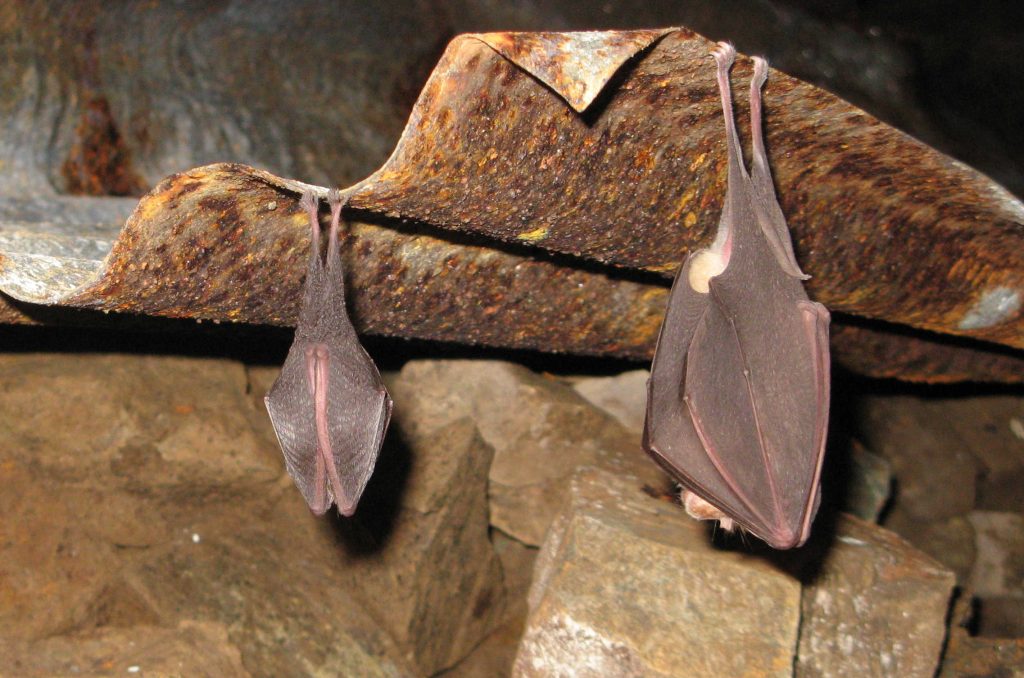
Contrary to popular belief, most bat species do not hang upside down in the loft; the overwhelming majority prefer to hide in small, confined spaces, leaving little indication of their presence.
There are many potential roost features (PRFs) in or on buildings (and trees), including where slates are missing/slipped, or tiles are missing / misaligned, and an internal membrane prevents a search of the underside of the slates/tiles. Additionally, missing mortar, gaps behind barge boards, etc., could all conceal bats.
In the words of the Bat Conservation Trust, ‘bats may be anywhere, but it does not mean that they are everywhere’ Consequently, most surveys result in no further action being required, and a report is generated to be presented to the Planning Officer to this effect.
Sometimes, however, no evidence is recorded, although there may be potential for bats to be present, but hidden from view. This is then assessed as a ‘potential roost’ and categorised according to the potential of whether bats are likely to present and, if so, in what numbers. This assessment determines the next course of action*:
- No / Negligible Potential – Usually indicates the end of the matter (although it is not unknown for the LPA ecologist to insist on further survey work).
- Low Potential – A minimum of one emergence survey. This assessment indicates low potential for presence, and, if present, only low numbers of bats.
- Moderate Potential – A minimum of two emergence surveys – This assessment indicates moderate potential for presence, and if present, moderate numbers of bats.
- High Potential – Usually, three emergence surveys are required; however, two might be sufficient, at the surveyor’s discretion. This indicates that the assessment has concluded that the potential roost could offer opportunities to a significant number of bats.
- Confirmed Roost – At least two emergence surveys are needed; sometimes three may be required.
*There are occasions when additional surveys are required. This is more likely where hibernation potential exists and might include winter surveys spread over several visits. It might also apply where particularly rare bats are present, and, in extreme cases, bats may be captured and fitted with radio-tracking equipment to assess their foraging/commuting areas.
The surveys are necessary for three reasons
- To check for presence/absence, to comply with the Law
- To provide the LPA with assurance that surveys have been undertaken in a compliant manner and thus that they can discharge their responsibilities.
- To provide the data required for a licence from Natural England, if required.
Classifying an assessment as negligible, low, moderate, or high potential is to some extent subjective. Still, it should be based on the perceived level of potential, the context, and the surveyor’s experience. Consequently, several ecologists may reach different conclusions. Ecologists with limited experience and knowledge are more likely to default to worst-case scenario recommendations.
All our surveyors are well-trained and experienced, and several are licenced by Natural England. All results are also subject to in-house peer review.
Bat Emergence Surveys (BES)
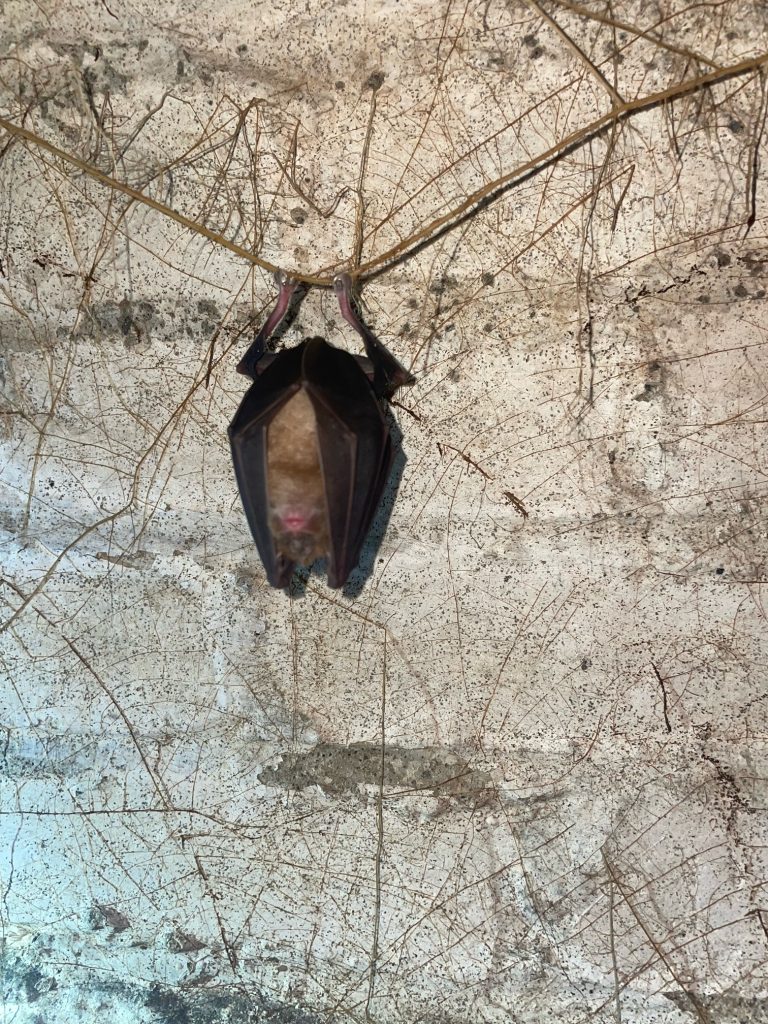
First and foremost, emergence surveys are intended to prove that the building is or is not a bat roost. Occasionally, it is possible that even though evidence of a roost was found, no bats emerge during the surveys. This could be for several reasons. Nonetheless, a roost is a roost, and the legislation does not specify when it ceases to be one, even without use. Consequently, a licence might still be necessary.
If bats are recorded, the survey records the access/exit point used by the bats, the numbers and species present and categorises the type of roost (there are many forms). Maternity and hibernation roosts are given the greatest importance, and strict timing of works will be necessary to avoid impacting these roosts. A decision is then taken on how to proceed. This could mean a Mitigation – Method Statement, or a Natural England European Protected Species Licence (EPSL). The exact requirements are dealt with on a case-by-case basis.
We prepare EPSL applications in-house, enabling us to apply to Natural England for European Protected Species Licences (EPSL) on your behalf. Most consultancies are unable to do this.
Please be aware that we are very reluctant to prepare a licence application based on another consultancy’s surveys and reports unless we have an established relationship with that consultancy.
Bat Activity Surveys (BAS)
Activity surveys are often required where development is to take place in a previously undeveloped area, such as agricultural fields, or on a brownfield site that has reverted to a more natural state.
Each site is individually assessed for its potential for foraging/commuting bats. In some areas, such as parts of Devon, Somerset, North Somerset, BANES, Dorset, Isle of Wight and Chichester, where light-sensitive bats are known to reside, the LPA will expect a BAS to be undertaken over a full season: April – October inclusive.
Generally, the minimum survey effort expected is for three walked transects to be undertaken, together with at least three ‘seasonal’ periods of automated detectors on site. The number of detectors depends on the hedgerows.
Sometimes, however, surveys are dictated by LPA policy and involve two monthly walked transects and twice-monthly automated recording periods – this can be very costly in terms of time, equipment, and analysis, and consequently in terms of cost to you.
Be aware that although BAS are more likely to be required on larger developments, the LPA can request them for any site.
Survey Objectives
The objective of the survey is to ascertain what, if any, bat species frequent the area and devise an appropriate mitigation scheme to ensure that bats currently using the site are not prevented from doing so in the future.
The survey effort is conducted in accordance with the Bat Conservation Trust (BCT) guidelines.
As with most aspects of planning, it is best not to wait until you are told to provide a report at the validation stage, as this would otherwise incur an avoidable long delay.
If in doubt, speak to us without delay.
Please contact us for a site-specific quotation –
Please call us on 0800 888 6846 (Office)
email: admin@ecological-surveys-ltd.co.uk
Be the change you wish to see